





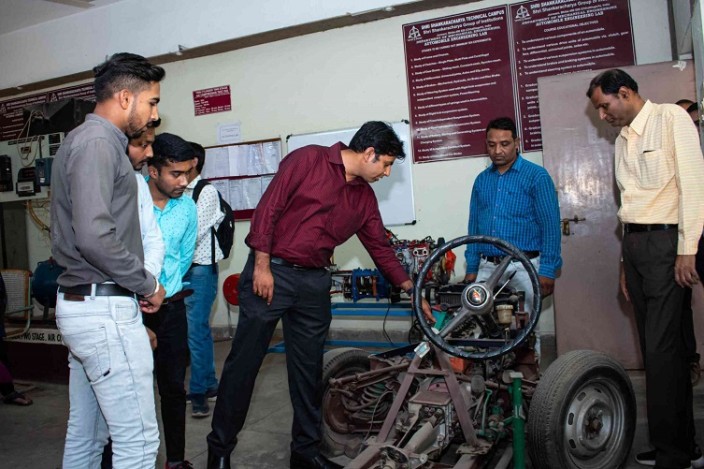
Mechanical Engineering department of SSTC was established in 2001 and offers B. Tech programme in Mechanical Engineering (NBA Accredited) and M. Tech programme in Machine Design, Thermal and Production Engineering. It is the broadest of engineering disciplines that offers a variety of career choices. Mechanical Engineers design, develop, build and test mechanical and thermal devices including tools, engines and machines. Mechanical engineers work mostly in engineering services, research and development, manufacturing industries and government sectors. The Courses offered by the department are AICTE approved and has a team of highly qualified and experienced faculty.
The department has the most modern infrastructure to undertake high-end teaching, research and developmental activities in its laboratories. The program at the postgraduate level aligns academic course work with research to prepare students in specialized areas within the field of mechanical engineering. Since its inception, the department has contributed in a big way to the society by providing technical manpower for various fields in India and abroad. Around 1900 graduates and 250 post graduates from the department are settled in very good positions all over the Globe . The faculty of the department continues to provide new frontiers of technical knowledge to the students by imparting quality education and research. Each year, our Engineers set the benchmark a step higher by securing placements in top companies.
To become a recognized department of the region in imparting professional knowledge of Mechanical Engineering with outcome based learning system.
| S.no. | Name of Course | No. of Seats |
|---|---|---|
| 1 | B. Tech. (Mechanical Engineering) | 120 |
| 2 | M. Tech. (Thermal Engineering) | 12 |
| 3 | Ph. D. | - |
| S. No. | Name of PI/Co-PI | Title of Project | Name of Funding Agency |
Total Grant Received (inLakhs) |
Duration of Project |
|---|---|---|---|---|---|
| 1 | Dr. Ajay Kumar Verma | Fabrication and Analysis of Hybrid Composite Reinforced with Fiber and Particulate Both | TEQIP-III, Chhattisgarh Swami Vivekanand Technical University, Bhilai (C.G.) | Rs. 2.89 Lac | 1 year |
| 2 | Mr. Vikky Kumhar | Design, testing and evaluation of a novel transplanting mechanism in manual rice transplanter for improved performance | TEQIP-III, Chhattisgarh Swami Vivekanand Technical University, Bhilai (C.G.) | Rs. 1.43 Lac | 1 year |
| 3 | Dr. P.V. Joshi | Modernization of Vibration lab by addition of experiment for measurement of vibration characteristics of plate beam using FFT analyzer. | AICTE, Delhi (MODROBS) | Rs. 7.60 lac | 1 year (2011-2012) |
| 4 | Dr.S.K.Dhagat | Upgradation of I/C Engine lab and inclusion of experiments on latest technology. | AICTE,Delhi (MODROBS) | Rs. 12.4625 lac | 2 years (2009-2011) |
| 5 | Mr.Mahesh Dewangan | Extraction of oil using pyrolysis reactor and its characterization. | TEQIP-III, Chhattisgarh Swami Vivekanand Technical University, Bhilai (C.G.) | Rs. 3.0 lac | 1year (2019-2020) |
| 6 | Dr. Lakshman Sondhi | Development of Functionally graded material and mechanical object like disc and plates | TEQIP-III, Chhattisgarh Swami Vivekanand Technical University, Bhilai (C.G.) | Rs. 2.0 lac | 1year (2019-2020) |
| 7 | Dr. J.K.Tiwari | Co-creating innovation and entrepreneurship. | TEQIP-III, Chhattisgarh Swami Vivekanand Technical University, Bhilai (C.G.) | Rs. 1.0 lac | 1year (2019-2020) |