About the Department
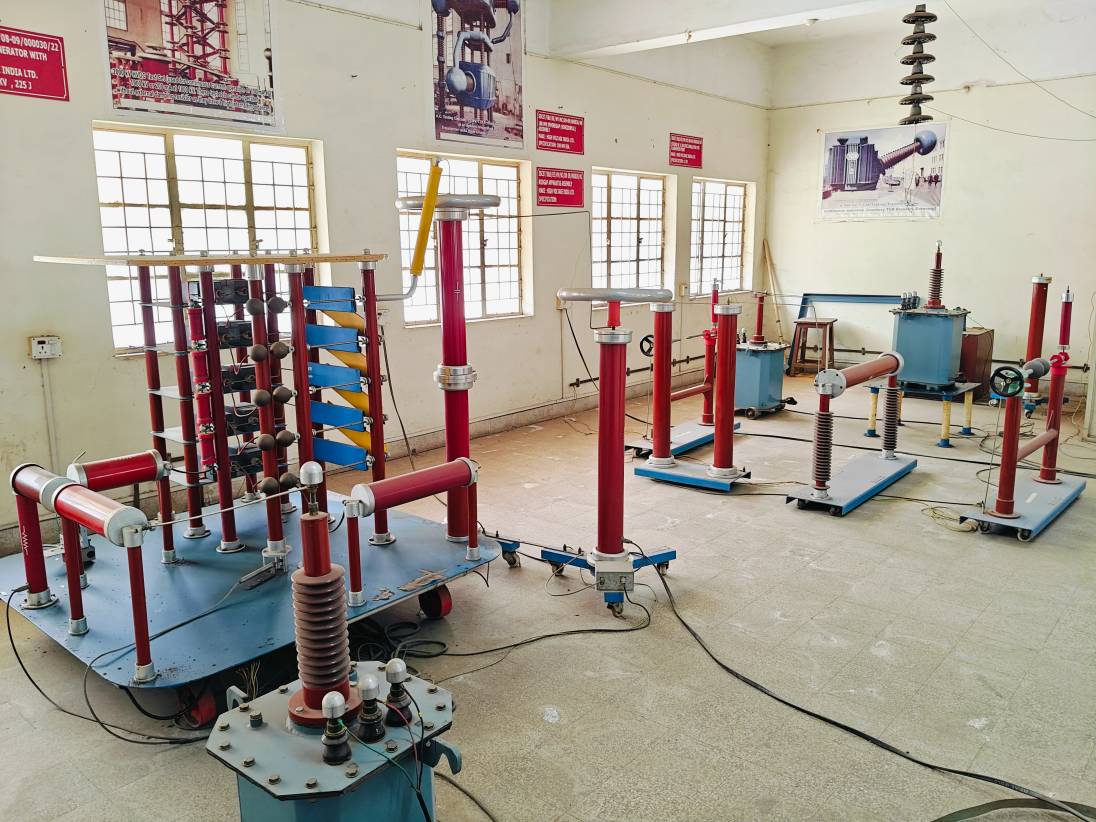
The department came into existence in the year 2007 with an initial intake of 60 and is affiliated to Chhattisgarh Swami Vivekananda Technical University with current intake of 120. The department is credited being the first in state to be accredited National Board of Accreditation (NBA) of AICTE for 3 years together with UG level intake and 18 at PG level (M.Tech.-Power System Engineering). The department makes use of innovative practices in teaching and learning. The institute MIS (EDRP) system provides rich resources such as educational CDs prepared by faculties of IITs, question banks, and online tests, access to books and journals etc. to both faculty and students. The department has well established 18 Labs, highly experienced , well qualified, committed faculty members and technical staff. Ten research scholars are actively doing research leading to Ph.D. in Electrical Engineering. The total intake has increased from 60 to 120 since the year 2017 onwards. At present there are 11 qualified and experienced faculty in the department.
The Department of Electrical Engineering has been approved as a Research Centre for carrying out research work leading to PhD degree. Emphasis is being given for industrial projects for the students. The students are encouraged to participate in extra-curricular activities, sports along with various competitions for overall personality development. The university result of 1st batch and 2nd batch was 100 % and in the third batch it was 98%. The department is having Industry Institute Partnership Cell which came into existence in the year 2009 onwards with the aid from AICTE in order to have regular interaction with the industries and to make the students aware regarding the problems/challenges in the industries. The department is also in collaboration with IIT Bombay spoken Tutorials, Code - Vita, E Litmus, AMCAT training so that the students game the maximum benefits of knowledge with current up gradations.
Vision
To become one of the leading department in the institute as well as at national level. The electrical Engineering program is designed to provide its graduates a solid educational foundation on which they can build successful and sustainable careers in electrical engineering or in a related field.
Mission
- To make the students learn Electrical engineering and Professional skills having field applications.
- To create an environment of lifelong learning through innovations, research and development.
- To create sense of responsibility, discipline and interest in various activities ultimately leading to service to the society.
Programme Specific Outcome (PSOs) for U.G. Programme
- Apply principles of engineering, Electronics and Computer Science, Physics, Chemistry, Environmental Science, Mathematics (including differential equations, discrete mathematics, linear algebra and complex variables) and laboratory skills for building, testing, operation and maintenance of high currents electrical systems, such as, Electrical Machines, Power and Energy Systems.
- Model, analyse, design, and realize physical systems, components or processes related to high current electrical engineering systems.
- Work professionally in power systems engineering, control systems engineering and software industries.
Programme Outcome (POs) for U.G. Programme
- Engineering knowledge:Apply the knowledge of Mathematics, Science, Engineering fundamentals, and an engineering specialization to the solution of complex engineering problems.
- Problem analysis: Identify, formulate, review research literature, and analyze complex engineering problems reaching substantiated conclusions using first principles of mathematics, natural sciences, and engineering sciences.
- Design/development of solutions: : Design solutions for complex engineering problems and design system components or processes that meet the specified needs with appropriate consideration for the public health and safety, and the cultural, societal, and environmental considerations.
- Conduct investigations of complex problems: Use research-based knowledge and research methods including design of experiments, analysis and interpretation of data, and synthesis of the information to provide valid conclusions.
- Modern tool usage: : Create, select, and apply appropriate techniques, resources, and modern engineering and IT tools including prediction and modeling to complex engineering activities with an understanding of the limitations.
- The engineer and society: Apply reasoning informed by the contextual knowledge to assess societal, health, safety, legal and cultural issues and the consequent responsibilities relevant to the professional engineering practice.
- Environment and sustainability: Understand the impact of the professional engineering solution sin societal and environmental contexts, and demonstrate the knowledge of, and need for sustainable development.
- Ethics: Apply ethical principles and commitment to professional ethics and responsibilities and norms of the engineering practice.
- Individual and team work: Function effectively as an individual, and as a member or leader in diverse teams, and in multidisciplinary settings.
- Communication: Communicate effectively on complex engineering activities with the engineering community and with society at large, such as, being able to comprehend and write effective reports and design documentation, make effective presentations, and give and receive clear instructions.
- Project management and finance: Demonstrate knowledge and understanding of the engineering and management principles and apply these to one's own work, as a member and leader in a team, to manage projects and in multidisciplinary environments.
- Life-long learning: Recognize the need for, and have the preparation and ability to engage in independent and life-long learning in the broadest context of technological change.
Courses Offered
| S.no. |
Name of Course |
No. of Seats |
| 1 |
B.Tech |
60 |
| 2 |
M.Tech |
18 |